What the review actually did
A systematic review is not somebody's opinion about the research. It is a defined procedure: specify the question in advance, search for every trial that meets the criteria, assess each one for bias, and combine the results. Cochrane reviews are the version of this most widely trusted by clinicians, largely because the method is published before the results are known — which makes it hard to steer the conclusion.
The 2023 review, led by Sumeer Singh and colleagues, looked for randomised controlled trials comparing blue-light filtering spectacle lenses against ordinary lenses in adults. It found 17, conducted across six countries and covering 619 participants in total. That is a small body of evidence for a product category this large, and the size is part of the finding.
Finding one: eye strain
This is the claim almost every product in the category is sold on, and it is the one the review addressed most directly. The conclusion was that blue-light filtering lenses may not attenuate symptoms of eye strain associated with computer use, compared with non-filtering lenses, over short-term follow-up.
Two details are worth holding onto. First, "may not" is careful language: the reviewers are describing evidence of low certainty that points away from a benefit, not a definitive proof of no effect. Second, the comparison is the important part. These trials did not test filtering lenses against nothing — they tested them against ordinary clear lenses. So this is not a finding that glasses do not help; it is a finding that the blue-light filtering is not what would be helping.
Finding two: eye health
Marketing in this category regularly implies protection against long-term retinal damage. On this point the review is unusually blunt: it found no randomised trial evidence relating to macular health at all. Not weak evidence, not conflicting evidence — none.
The AAO's position runs alongside that. It states there is no scientific evidence that the type or amount of light coming from computer screens damages the eye. The quantities involved are orders of magnitude below daylight; if screen light were hazardous at these levels, going outdoors would be considerably worse.
Finding three: sleep
Here the review declined to reach a conclusion, calling the potential effects on sleep quality indeterminate, with the included trials reporting mixed outcomes across quite different groups of participants.
We treat this differently from the eye-strain question, because the underlying biology is not in doubt. Short-wavelength light is the dominant signal to the retinal cells that set circadian timing. The open question is narrower: does a pair of consumer glasses remove enough of it, for long enough, to shift anything you would notice? We go through those trials individually here.
What the review could not tell you
Honest reporting means flagging the limits of the finding as well as the finding itself:
- Follow-up was short. The longest trials ran weeks, not years. A slow-accumulating benefit would not show up.
- The lenses varied. Trials used everything from near-clear lenses that remove very little short-wavelength light to heavily tinted ones. Pooling them can dilute a real effect that only the strong filters produce.
- The trials were small. With 619 people spread across 17 studies, a modest benefit in a subgroup would be difficult to detect.
- Blinding is genuinely hard. Anyone can see whether their lenses are tinted, which makes placebo-controlled design difficult in a way it is not for a pill.
None of this rescues the eye-strain claim. It does mean the correct summary is "the evidence does not support the claim" rather than "the claim has been disproved" — and it means a future, better-designed trial could change the picture, particularly on sleep.
So why do so many people say they help?
Because people who buy them often do feel better, and that experience is real even when the mechanism isn't the one on the box. A few explanations fit the evidence better than filtering does:
- Placebo effects are large for subjective symptoms like discomfort and fatigue. This is precisely the outcome type where they dominate.
- Buying glasses changes behaviour. People who invest in a solution tend to also start taking breaks, adjusting their monitor, and paying attention to how they work.
- Any lens in front of the eye slightly reduces airflow across the ocular surface, which can ease dryness — clear lenses do this too.
- Some buyers get a prescription or an anti-reflective coating at the same time. Both do have plausible mechanisms, and both get credited to the blue filter.
Where we'd put your money instead
In rough order of how well supported each one is: an eye exam, if you have not had one in two years or you are past forty. Then the working setup — screen position, glare, text size, room lighting. Then the habit of interrupting the stare every twenty minutes or so. Then, if dryness is the dominant symptom, lubricating drops and a look at the airflow at your desk.
A pair of blue light glasses costs less than most of that list. It also does less. Plenty of people will want a pair regardless, and that is a reasonable decision to make with the evidence in front of you — the products are cheap, and nothing here suggests they do harm. If that is you, two things decide whether the money is well spent: match the lens to your actual goal, and put the money into the frame rather than the filter.
Buying anyway? Match the pair to your reason
Nothing above says these are harmful — only that the filtering is not the part doing the work. Choose on frame quality and lens tint instead.
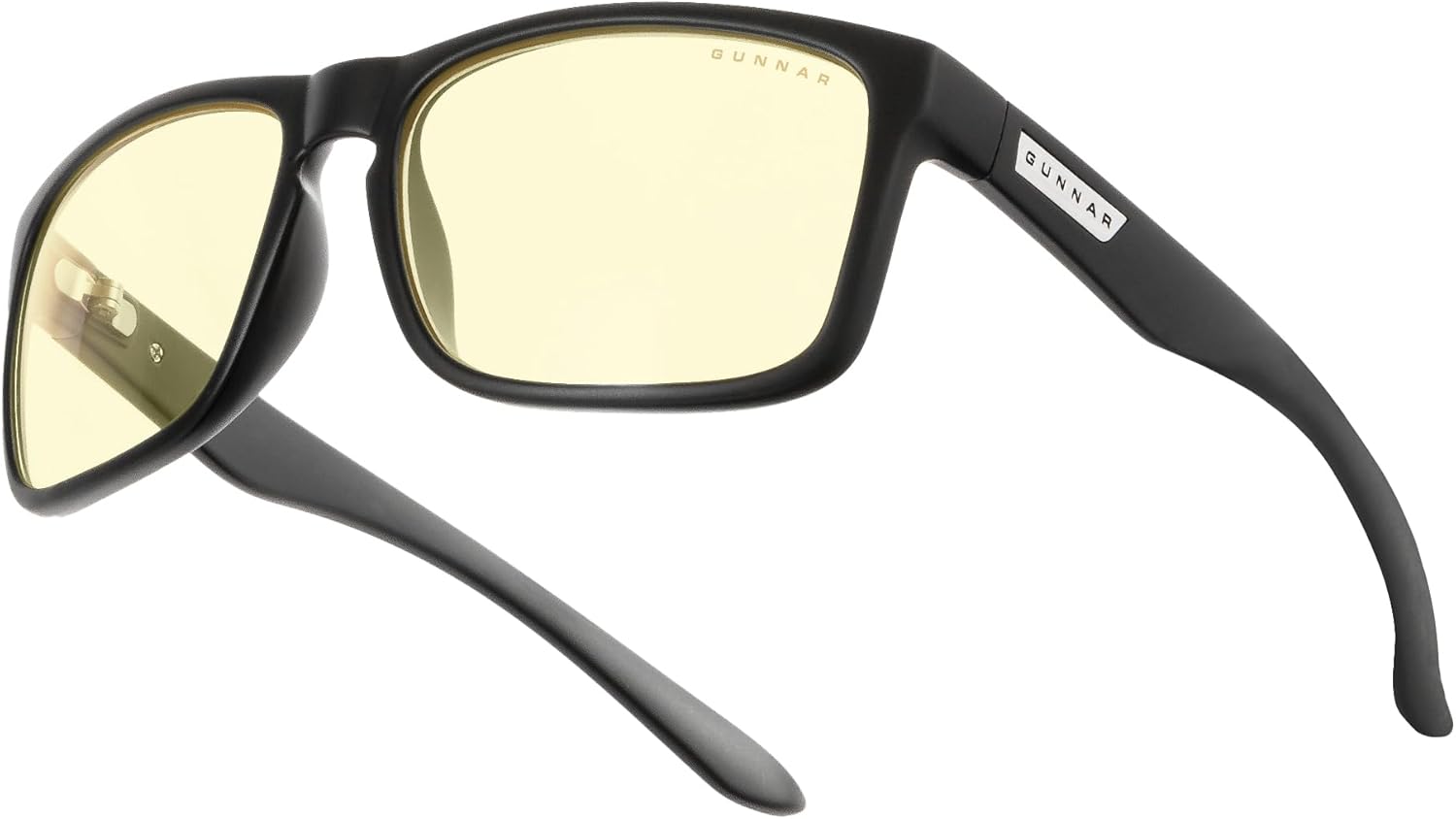
Best Overall
GUNNAR Gaming Eyewear
Usually $60 and up
The frame that lasts, from the one brand that publishes its numbers. Buy it once you know you will wear a pair.
Check current priceRead the full review
Best Budget
TIJN Blue Light Frames
Usually under $25
The cheap way to find out whether you will actually wear these. Ordinary frames, ordinary price, no pretence.
Check current priceRead the full review
Best for Evening Wind-Down
Uvex Skyper (SCT-Orange Lens)
Usually under $25
The only lens here deep enough to test the evening-light idea properly. Cheap, effective at that one job, and unwearable in public.
Check current priceRead the full review
Affiliate links — we earn a commission if you buy, at no extra cost to you, and it does not change what we recommend. How we evaluate · disclosure
The full reasoning behind each one, including what we cannot verify, is on our buying page.