Step one: name the goal, because it changes the lens
The single most common buying mistake in this category is choosing a lens that cannot do the job the buyer had in mind.
- Evening use, testing the circadian idea: you need a deeply tinted amber or orange lens. A near-clear lens removes too little short-wavelength light to be a fair test.
- Daytime screen work, on camera: a near-clear lens is the only one that will not colour-shift your face on video. Accept that it is doing very little optically, and pay accordingly.
- Colour-critical work of any kind — design, photography, medical imaging: no tinted lens. This is not a close call.
- General discomfort at a screen: an anti-reflective coating and a correct prescription will do more than any filter. Buy those instead.
Step two: work out whether you need a prescription
If you already wear glasses, buying non-prescription filtering glasses to wear at the computer means choosing between seeing clearly and filtering — which is not a choice worth having. Get the filter added to a prescription lens, or skip it.
If you do not wear glasses but you are over forty, or you have not had an eye test in a couple of years, get one before you buy anything. The symptoms that send people to this category are frequently uncorrected refractive error, and an exam is the only step here with a clear mechanism. More on that decision here.
Step three: ignore the filtering percentage unless it names a wavelength
A percentage without a wavelength range is not a specification. A lens can legitimately advertise 90% blocking by measuring at a narrow band near 410 nm while passing nearly all of the 460–480 nm light that matters for circadian timing. Very few consumer sellers publish a transmission curve; those that do are giving you something checkable and deserve credit for it.
In the absence of data, the tint is the honest signal. Visibly amber means substantial filtering. Visibly clear means minimal filtering. The optics behind that are here.
Step four: judge the frame, since that is what you are really buying
Once you accept that the filtering is the uncertain part, the frame is what your money is actually purchasing — and frames differ in ways you can assess.
- Fit is the whole game. A frame that pinches at the temples or slides down your nose will end up in a drawer regardless of its lens.
- Check the frame measurements printed on the temple arm against a pair you already own. This tells you more than any face-shape chart.
- Metal wire frames bend back into shape; acetate cracks. Acetate is warmer against the skin and holds adjustment better.
- Spring hinges survive daily handling better than plain screw hinges, whatever the price bracket.
How to read frame measurements is a five-minute read and will save you a return.
What more money buys, honestly
Moving from a $15 pair to a $70 pair generally buys better hinges, more consistent lens quality, a frame material that holds its shape, a warranty, and a returns process staffed by someone who answers. Those are real. What the premium does not buy is a filtering benefit the evidence supports — the Cochrane finding applies to expensive lenses exactly as it applies to cheap ones.
Our rule: buy at one end of the range or the other. If you know you will wear a pair every day, buy the better frame and expect it to last. If you are still finding out, spend $15 and find out cheaply. The middle of this market is where the marketing does the most work and the value is thinnest.
The checklist, condensed
1. Get the prescription right first
An uncorrected or out-of-date prescription — especially small amounts of astigmatism, or early presbyopia in your forties — produces exactly the symptoms people blame on blue light. An eye exam costs less than a premium pair of filtering glasses and is the only step here with a clear mechanism behind it.
2. Decide which claim you are actually buying
The eye-strain claim is the one the trial evidence does not support. The evening-light claim is unresolved but has a real mechanism. These need different lenses: a near-clear lens does almost nothing to short-wavelength light, so buying one for sleep reasons is self-defeating.
3. Ask whether the seller publishes transmission data
Most do not. A percentage on a marketing page with no wavelength range attached is close to meaningless — "blocks 90% of blue light" can be true of a narrow slice of the spectrum and irrelevant everywhere else. Sellers who publish a curve or a per-wavelength figure are giving you something checkable.
4. Do not pay a premium for the filter
Since the filtering is the unproven part, paying more for it is paying more for the part that is least likely to matter. Pay for the frame, the fit, and the prescription instead.
5. Check the return policy before the reviews
Fit is the thing you cannot assess online, and it is the thing most likely to make you stop wearing a pair. A retailer that takes returns without argument is worth more than a slightly better lens claim.
Claims that should make you close the tab
- “Protects your retina” or “prevents macular degeneration.” There is no randomised trial evidence on macular health from these lenses, and the AAO states screen light is not known to damage the eye.
- “Clinically proven to reduce eye strain.” The pooled evidence points the other way. A single small trial funded by a seller is not clinical proof.
- “Blocks 100% of blue light” on a clear lens. That would make the lens opaque to blue. It is not physically consistent.
- Countdown timers, invented “was” prices, and review counts that jump between page loads. These say something about the seller regardless of the optics.
Applying all of that
Three picks that survive the checklist above — one for each of the goals in step one.
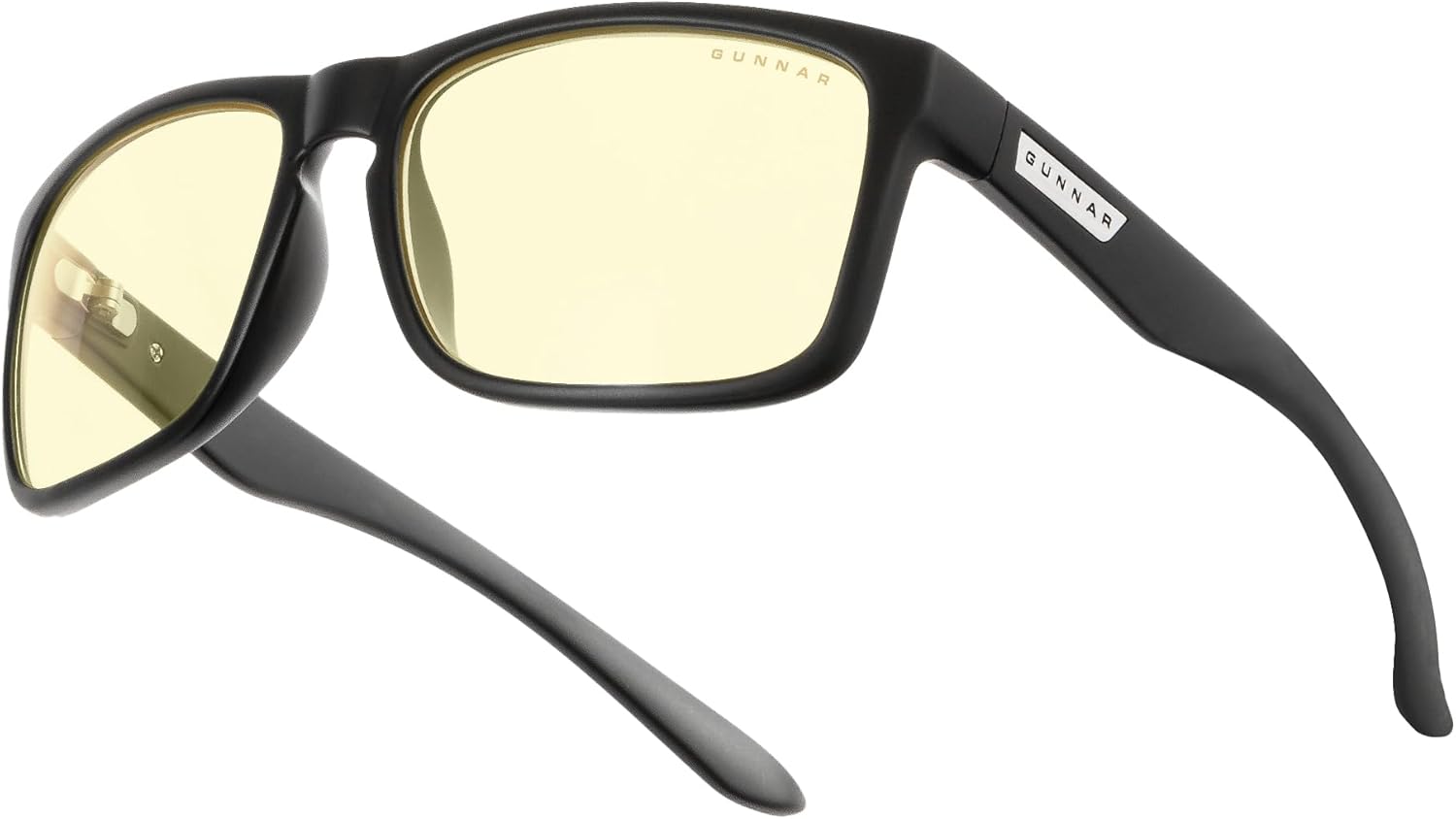
Best Overall
GUNNAR Gaming Eyewear
Usually $60 and up
The frame that lasts, from the one brand that publishes its numbers. Buy it once you know you will wear a pair.
Check current priceRead the full review
Best Budget
TIJN Blue Light Frames
Usually under $25
The cheap way to find out whether you will actually wear these. Ordinary frames, ordinary price, no pretence.
Check current priceRead the full review
Best for Evening Wind-Down
Uvex Skyper (SCT-Orange Lens)
Usually under $25
The only lens here deep enough to test the evening-light idea properly. Cheap, effective at that one job, and unwearable in public.
Check current priceRead the full review
Affiliate links — we earn a commission if you buy, at no extra cost to you, and it does not change what we recommend. How we evaluate · disclosure
The longer write-up of each — including what we have and have not verified — is on our picks page.