Buying

What we’d buy, and why

Read this second. The first thing to know is that the trial evidence does not support the eye-strain claim these products are sold on — so the goal here is to spend as little as possible on the unproven part, and get something that fits well.

Last reviewed August 2026. We update a page when the underlying evidence changes, not on a schedule.

The honest summary in one paragraph

If you want to test the evening-light idea on yourself, buy a deeply tinted lens — a near-clear one filters too little to be a fair test. If you want the accessory for daytime screen work, buy the cheapest frame you actually like the look of, because the filtering is the part with no proven benefit and it costs the same to make either way. If your eyes hurt every day, spend the money on an eye exam instead. That is the whole recommendation; the detail below is just the reasoning.

The retailer links below are affiliate links. If you buy through one, we earn a commission at no extra cost to you. It does not change what we recommend, and we recommend against buying in several places on this site. Full disclosure.

Evening wind-down, if you want to try the circadian idea

Uvex Skyper (SCT-Orange lens)

Lens tint
Deep orange
Price
Usually under $25

If you want to test whether cutting evening short-wavelength light does anything for you, the sensible test is a lens that removes a lot of it. A deep orange safety lens does that visibly and costs less than most fashion pairs. Several of the small sleep trials used lenses of roughly this type rather than the near-clear lenses sold as "blue light glasses".

The tradeoffs

  • Colour rendering is heavily shifted. You cannot do design work, judge photos, or take a video call in these.
  • Wrap-around safety styling. Most people will not want to be seen in them outside the house.
  • Comfort is adequate rather than good — these are made to a safety spec, not for eight-hour wear.

Not for: Daytime or office use, and anyone who wants glasses that look like glasses.

Manufacturer claim, not our measurement: Marketed as an SCT-Orange safety lens that absorbs short-wavelength light. Honeywell publishes it as industrial eyewear, not as a sleep aid.

Check current price

A cheap, unobtrusive everyday frame

TIJN blue light frames

Lens tint
Clear to faint amber, varies by model
Price
Usually under $25

If you have decided you want a pair regardless of what the trials say, the rational move is to spend as little as possible, because the filtering itself is the part with no proven benefit. TIJN sells acetate frames in a wide range of shapes at the bottom of the price range, and the frames themselves are ordinary, serviceable eyewear.

The tradeoffs

  • Acetate frames crack rather than flex if you sit on them.
  • Some models carry a visible warm tint, which shows up on video calls.
  • No published optical data, so you are buying a frame and accepting the lens claim on trust.

Not for: Anyone expecting a measurable filtering spec, or anyone who needs a prescription.

Manufacturer claim, not our measurement: Filtering percentage is stated inconsistently across listings and no transmission data is published. Treat any figure on the listing page as unverified.

Check current price

A near-clear lens for on-camera work

SOJOS metal-frame blue light glasses

Lens tint
Near-clear
Price
Usually under $25

The main practical difference between clear and tinted lenses is how you look on a webcam. If you want the accessory without a colour cast, a near-clear lens in a thin metal frame is the least intrusive version of it. Be clear-eyed about the trade: a lens that removes very little short-wavelength light is a lens that changes very little.

The tradeoffs

  • The filtering is minimal by design. If your interest is the circadian effect, this is the wrong category of lens.
  • Thin wire frames bend back into shape but the hinge screws work loose over time.

Not for: Evening use aimed at sleep.

Manufacturer claim, not our measurement: Advertised as blue light filtering; no transmission curve published. Near-clear lenses filter only a small share of the blue band — that is what makes them look clear.

Check current price

The premium end — and where we would stop before buying

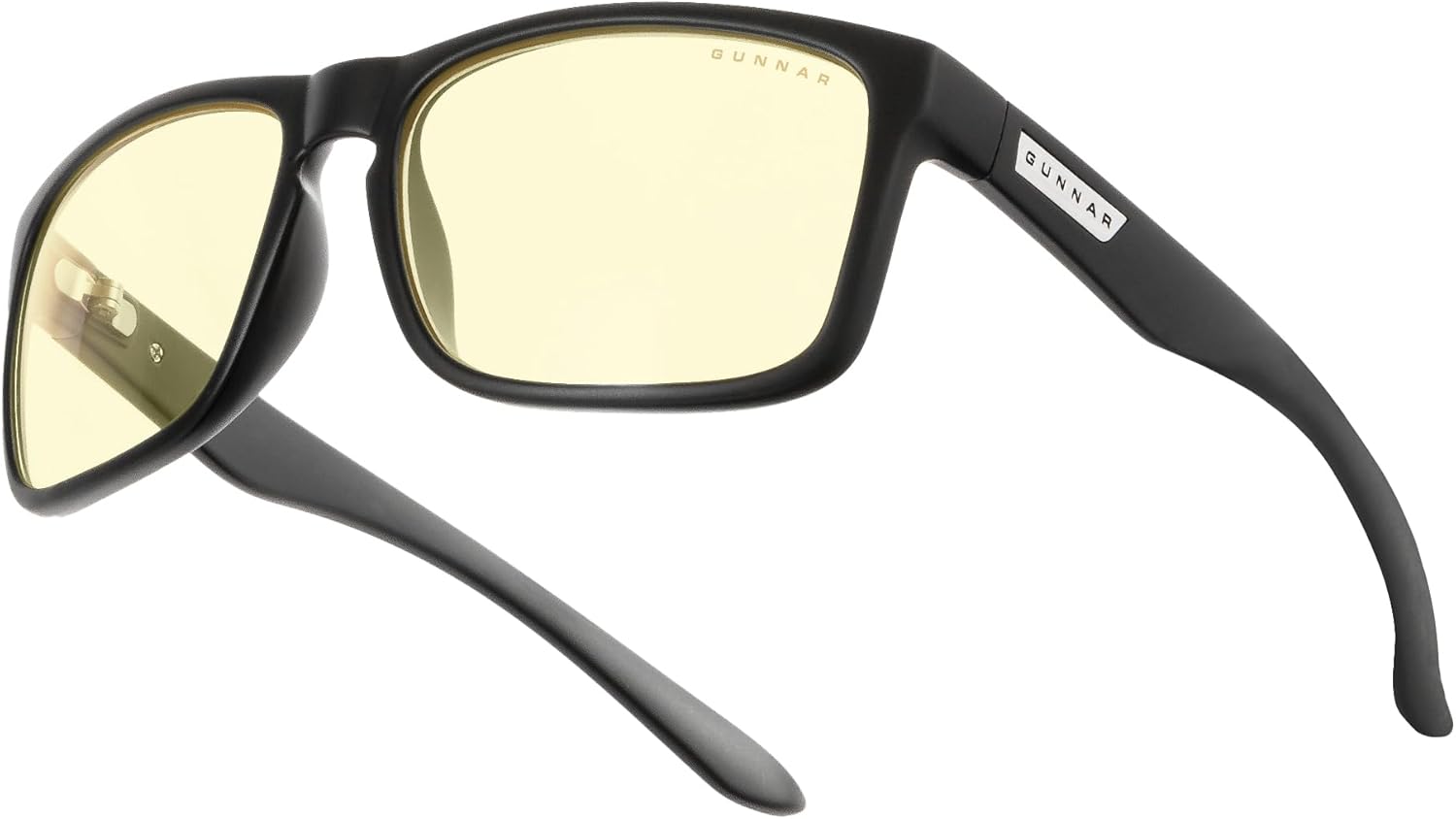
GUNNAR gaming eyewear

Lens tint
Amber (most models) or clear
Price
Usually $60 and up

GUNNAR is the most credible brand in the category on disclosure and build, and its frames are genuinely better made than the $15 alternatives. We list it so you can see what the premium buys. What it does not buy is a proven benefit — the Cochrane evidence applies to expensive lenses exactly as it applies to cheap ones.

The tradeoffs

  • Three to five times the price of budget frames for a benefit the trial evidence does not support.
  • The amber tint shifts colour noticeably, which matters for design and video work.

Not for: Anyone buying primarily for the filtering rather than the frame. At this price, an eye exam and a properly fitted prescription is a better use of the money.

Manufacturer claim, not our measurement: GUNNAR publishes filtering figures per lens tint, which is more disclosure than most of the category offers. The figures are the company's own.

Check current price

If you need a prescription

This is the case where a purchase is most likely to help, and the reason has nothing to do with blue light. Correcting a refractive error you have been squinting through is one of the few interventions with a clear mechanism behind screen-related fatigue. Both retailers below sell prescription lenses cheaply and offer filtering as a paid add-on. Our view is that the prescription is worth the money and the add-on is optional.

  • Zenni Optical

    Sells prescription lenses at the low end of the market and offers blue-light filtering as an add-on. The add-on is optional — the prescription is the part that affects eye strain.

    Check current price
  • EyeBuyDirect

    Similar model: inexpensive prescription lenses with a filtering upgrade priced separately. Useful mainly as a way to buy a correct prescription cheaply.

    Check current price

An online retailer cannot substitute for an eye exam. You need a current prescription and your pupillary distance before ordering, and both come from a clinician.

Five questions worth asking before you order

1

Get the prescription right first

An uncorrected or out-of-date prescription — especially small amounts of astigmatism, or early presbyopia in your forties — produces exactly the symptoms people blame on blue light. An eye exam costs less than a premium pair of filtering glasses and is the only step here with a clear mechanism behind it.

2

Decide which claim you are actually buying

The eye-strain claim is the one the trial evidence does not support. The evening-light claim is unresolved but has a real mechanism. These need different lenses: a near-clear lens does almost nothing to short-wavelength light, so buying one for sleep reasons is self-defeating.

3

Ask whether the seller publishes transmission data

Most do not. A percentage on a marketing page with no wavelength range attached is close to meaningless — "blocks 90% of blue light" can be true of a narrow slice of the spectrum and irrelevant everywhere else. Sellers who publish a curve or a per-wavelength figure are giving you something checkable.

4

Do not pay a premium for the filter

Since the filtering is the unproven part, paying more for it is paying more for the part that is least likely to matter. Pay for the frame, the fit, and the prescription instead.

5

Check the return policy before the reviews

Fit is the thing you cannot assess online, and it is the thing most likely to make you stop wearing a pair. A retailer that takes returns without argument is worth more than a slightly better lens claim.

Haven't read the evidence yet?

Start with what the trials found, or with the things that do reduce screen fatigue. Both are free, and one of them might save you the purchase.

Sources for this page

  1. Blue-light filtering spectacle lenses for visual performance, sleep, and macular health in adults
    Singh S, Downie LE, Anderson AJ, et al.Cochrane Database of Systematic Reviews, 2023, Issue 8
    Systematic review of 17 randomised controlled trials (619 participants, 6 countries)
  2. Are Blue Light-Blocking Glasses Worth It?
    American Academy of Ophthalmologyaao.org patient education
    Professional body position statement
  3. FTC Guides Concerning the Use of Endorsements and Testimonials in Advertising
    U.S. Federal Trade Commissionftc.gov, 2023 revision
    Regulatory guidance